
Dogs have extraordinary hearing, detecting sounds from 40 Hz to 60,000 Hz—far beyond human range. Their ears can move independently, helping them pinpoint the direction of a sound. This makes dogs highly aware of their environment, able to hear distant noises or subtle changes in human voices. Understanding how a dog hears explains why they respond quickly to alerts and communicate with humans and other animals.
How Dogs Hear the World
Dogs have a keen sense of hearing, far surpassing humans. While humans detect sounds up to ~20,000 Hz, dogs hear frequencies between 47,000–65,000 Hz. They can perceive softer sounds (-5 dB to -15 dB) and notice tiny frequency differences, like ⅛ of a musical note.
A dog’s ears gather sound waves efficiently. With 15 muscles, each ear can move independently, helping dogs locate the direction of a sound and absorb more noise.
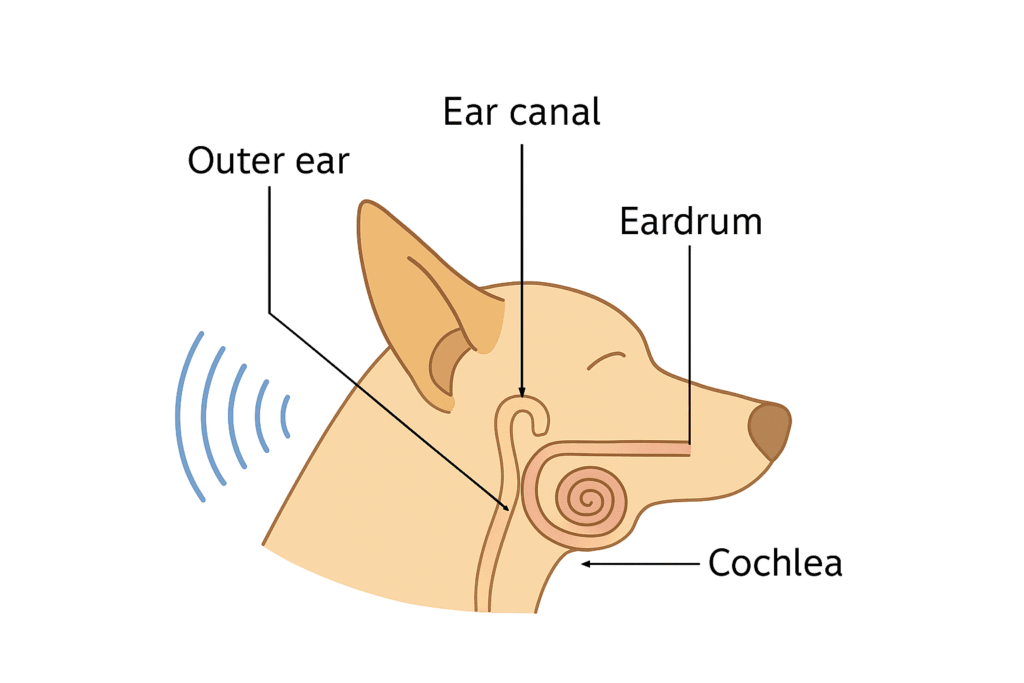
This explains how dogs hear four times better than humans and can detect sounds from farther away—like vacuum cleaners, drills, or distant car engines.
Evolution also shaped their hearing. As predators, dogs developed sensitivity to high-pitched prey sounds, with maximum sensitivity around 8,000 Hz, compared to 2,000 Hz in humans. BAER tests confirm this precise auditory capability. Aging and ear infections can reduce hearing, but high-frequency sounds usually persist the longest.
Understanding how dogs hear reveals why they react quickly to subtle noises and communicate effectively with humans and other animals.
The Incredible Anatomy of Dog Ears
Dogs have highly specialized ears designed for precise hearing. The pinnae, or external ear flaps, are highly mobile, powered by more than 20 separate muscles, allowing up to 180 degrees of movement. These pinnae act as funnels, directing sounds into the external ear canal, while droopy ears can slightly dampen loud noises, protecting sensitive structures.
The ear canal channels sound waves toward the tympanum (eardrum), a thin, dog tympanic membrane that vibrates in response to even faint sounds. Behind it, the middle ear bones amplify and transmit vibrations to the inner ear, which contains tiny hair cell receptors immersed in specialized fluid. These hair cells convert sound waves into nerve signals sent to the auditory cortex in the brain for processing.
This anatomy enables dogs to hear sounds up to four times farther away than humans and detect subtle frequency differences, which explains why they can predict storms or respond to distant noises. Certain genetic abnormalities, such as those in Merle or white-coated dogs, can cause abnormal hair cell development, leading to congenital deafness.
In short, a dog’s ear structure — from pinnae to inner ear — is a finely tuned system that maximizes sensitivity and directional hearing, giving them their keen auditory abilities.
Why Dogs Move Their Ears So Much
Dogs have highly mobile ears, with about 18 muscles in each ear, though the exact number can vary by breed. This allows them to move each ear independently, enhancing their ability to detect and respond to sounds.
Reasons dogs move their ears:
Locate sound direction: Independent ear movement helps pinpoint where a sound is coming from.
Absorb and amplify sounds: Rotating, tilting, raising, or lowering ears improves sound detection.
Communication signals: Ear positions convey mood, alertness, and intentions to other dogs and humans.
Breed-specific abilities: Some breeds with dog ear folds or upright ears have slightly different mobility and sensitivity.
This ear mobility is key to their keen hearing and explains why dogs react to subtle noises humans may not notice.
Hearing Range & Frequency Sensitivity
Dogs have an extraordinary hearing range, detecting sounds humans can’t perceive.
Frequency & sensitivity facts:
Canine auditory range: Up to 47,000–65,000 Hz, while human hearing tops at ~20,000 Hz.
Low-level detection: Dogs can sense very soft sounds, as quiet as -5 dB to -15 dB.
Maximum sensitivity: Most sensitive around 8,000 Hz, compared to humans at ~2,000 Hz.
Frequency discrimination: Can detect tiny differences, like 1/8 of a musical note (C vs. C♯).
High-pitched detection: Hear ultrasonic sounds, e.g., rodent squeaks, dog whistles, vacuum cleaners, and drills.
Distance advantage: Can detect sounds up to four times farther than humans.
Survival heritage: Predatory ancestry enables the detection of prey movements and high-frequency noises.
Sound perception examples: Earthquakes, car engines, and human voice pitch variations.
Dogs’ auditory precision combines frequency range, soft sound detection, and directional hearing, making their hearing vastly superior to humans.
Why Dogs Tilt Their Heads
Dogs tilt their heads to better locate sounds. By adjusting each ear independently, they can pinpoint the source more accurately, especially high-frequency or faint noises. This behavior improves auditory perception and may also help align their eyes and ears for better focus on visual and sound cues. Head tilting also aids communication with humans. Dogs lean or adjust their posture to hear commands, tones, or speech clearly, showing attention and curiosity. It’s a mix of biological adaptation and social behavior, highlighting how sensitive and intelligent a dog’s hearing truly is.
How Dogs Use Hearing to Communicate

Dogs use different sounds to communicate emotions, warnings, and intentions. Barking can indicate alarm, alerting owners to strangers or unusual events, while high-pitched, repeated barks often signal excitement or play. Whining is usually linked to care-seeking, stress, or puppies calling their mother. Growling conveys a warning or defensive signal, with low-frequency growls often tied to larger dogs and higher intensity warning of immediate danger.Howling is context-dependent and can respond to other dogs or environmental cues. Individual dogs and breeds vary in vocalization patterns, and acoustic features help listeners identify the vocalizing dog. Observing body language, like dogs’ ears going back, complements the sounds and clarifies intent. This rich combination of vocal sounds and ear positioning enables dogs to communicate effectively with humans and other dogs.
Hearing and Dog Emotions
A dog’s hearing directly influences its emotional state. Calm dogs often show relaxed ear positions, while anxious or fearful dogs may have ears pulled back, signaling stress. Sudden or loud sounds, such as fireworks, gunfire, lawn machinery, or household appliances, can trigger strong fearful responses. Studies show that almost half of the pet population experiences some form of noise phobia, which may be worsened by underlying chronic pain or behavioral conditions.
Noise sensitivity can lead to separation anxiety, storm phobias, or other distress behaviors. Treatment options vary, including behavioral therapy, pheromones, supplements, and medication when needed, to help dogs cope with extreme noise. Observing what it means when a dog’s ears are back allows owners to gauge their pet’s fear levels and respond appropriately, keeping them safe and emotionally balanced.
Do Dogs Enjoy Music?
Dogs respond to music in ways that reflect their acute hearing abilities. Studies show classical music often calms them, reducing restlessness and promoting quieter behavior. In contrast, rock or heavy metal tends to increase barking and agitation, likely due to higher volume, fast tempo, and intense timbre.
Factors such as pitch, rhythm, and habituation play a role—dogs repeatedly exposed to certain styles may show consistent reactions over time. Pop music and softer melodies produce intermediate effects, with dogs sometimes more attentive but not stressed. Overall, music can influence dogs’ behavior temporarily, offering a simple way to enrich their environment and support relaxation.
Puppy Hearing Development
- Puppies are born with their ear canals closed, making them completely deaf at birth.
- During the first 1–2 weeks of life, the canals begin to open gradually.
- By around 3 weeks, most puppies start responding to sounds as their auditory system develops.
- Full hearing typically develops between 4–8 weeks of age, depending on the breed and individual variation.
- Puppies with long ears or droopy ears may experience slightly delayed sound exposure, but their hearing matures normally.
- Early auditory development is critical for socialization, communication, and learning environmental cues.
Different Dog Ear Shapes
- Pricked ears: Stand upright, like German Shepherds and Malamutes. They capture sounds efficiently, improving directional hearing.
- Floppy ears: Hang down, like Cocker Spaniels and Beagles. Slightly reduce sound localization but protect from debris.
- Semi-pricked ears: Partially upright, like Collies. Balance between sound capture and protection.
- Rose ears: Folded backward with tips pointing down, seen in some sheepdogs. Moderate hearing efficiency with expressive movement.
- Bat ears: Large, upright, rounded at the top, like French Bulldogs. Excellent at detecting distant or high-frequency sounds.
- Round or blunt ears: Small, rounded, like Pugs. Less directional sensitivity but still effective for everyday hearing needs.
These ear shapes influence how dogs detect sound direction, frequency, and intensity, with upright shapes generally providing sharper auditory perception.
The Hidden “L” Shape of a Dog’s Ear Canal
A dog’s ear canal isn’t straight like a human’s — it’s shaped like a distinct “L.” This means sound waves first travel down a vertical canal before turning horizontally toward the eardrum (tympanic membrane). This curved structure enhances protection by preventing sharp objects, dirt, and moisture from directly reaching the inner ear. However, this same design makes dogs more prone to ear infections, as debris, yeast, and bacteria can easily get trapped inside.
Because of this L-shaped ear canal anatomy, even small particles like grass seeds or dust may stop midway instead of exiting naturally. Breeds with heavy ear flaps (like Spaniels and Retrievers) are especially vulnerable since reduced airflow keeps the canal warm and moist — the perfect environment for infection. Regular cleaning and gentle ear checks help keep a dog’s ears healthy without disturbing their sensitive hearing system.
Common Hearing & Ear Problems
Dogs often face ear infections, one of the top reasons for vet visits. Their L-shaped ear canals trap moisture, wax, and debris, allowing yeast or bacteria to grow. If a dog’s ear hurts when touched, feels hot, or smells bad, it’s likely infected.
Other common issues include:
- Ear mites or wax buildup – cause itching and head shaking.
- Grass seeds or debris – get lodged inside, leading to irritation.
- Ear plucking – can hurt dogs if done harshly.
- Age or injury-related deafness – damages hearing over time.
Prevention: Regularly check and gently clean your dog’s ears with a vet-approved solution. Watch for signs like ears down, redness, or odor. Early care helps prevent long-term ear health problems.
How to Protect & Support Your Dog’s Hearing
A dog’s hearing is one of its most powerful senses, and protecting it requires simple, consistent care. Here’s how to keep your pup’s ears healthy and sound-sensitive for years:
- Avoid loud noises: Keep dogs away from fireworks, heavy traffic, or loud music. Prolonged exposure can cause stress and long-term hearing loss.
- Clean ears safely: Use a vet-approved ear cleaner once a week. Avoid cotton swabs that push wax deeper into the canal.
- Regular vet check-ups: Schedule ear exams, especially if your dog frequently shakes its head or scratches its ears.
- Monitor noise sensitivity: Dogs with anxiety around loud sounds may benefit from calming environments or desensitization training.
- Protect during baths: Always dry ears thoroughly after swimming or bathing to prevent infections.
Small preventive steps go a long way. Proper ear care not only prevents hearing problems but also helps your dog stay alert, comfortable, and confident in every environment.
Fun & Surprising Facts About Dog Hearing
- Super hearing: Dogs detect sounds from 45–67,000 Hz, far above human range.
- Storm sense: They often react to thunder and air pressure before humans notice.
- Earthquake alerts: Dogs can sense vibrations seconds before tremors hit.
- Termite detectors: Their ears pick up tiny insect vibrations hidden in walls.

- Sound precision: Dogs locate noises with a difference as small as ⅛ of a musical note.
- Ear control: With 18+ muscles, dogs move each ear independently for better focus.
- Breed factor: Upright ears (like German Shepherds) hear better than floppy ones.
- Ultrasonic hearing: Dog whistles work because dogs hear high frequencies humans can’t.
- Corn chip smell: A mild yeast buildup can make ears smell like Fritos.
- Longest ears: The Bloodhound “Tigger” holds the record—13 inches each!
- Ear language: Dogs show feelings through ear positions—up = alert, back = friendly, flat = fear.
Each flick and tilt of a dog’s ear shows how finely tuned—and expressive—their hearing really is. From detecting storms to understanding your tone, a dog’s ears do far more than hear — they connect them deeply to the world and to you.