
People often search for Great Blue Heron facts because this calm, statuesque bird hides remarkable behaviors.
The Great Blue Heron (Ardea herodias) is a large wading bird of North America.
It shows impressive survival skills, hunting techniques, and daily life adaptations.
| Feature | Measurement |
| Height | 3.2–4.5 ft (38–54 inches) |
| Head-to-Tail Length | 36–54 inches |
| Wingspan | 5.5–6.6 ft (66–79 inches) |
| Weight | 4–6 pounds (1.8–2.5 kg) |
| Lifespan | 15–24 years |
| Habitat | Wetlands, lakes, rivers, coasts |
| Diet Overview | Fish, amphibians, insects, small mammals |
Taxonomy and Scientific Classification
The Great Blue Heron belongs to one of the oldest groups of long-legged wading birds.
Biologists classify it under the genus Ardea, which includes several large heron species.
Its scientific name, Ardea herodias, reflects its size and close relation to other herons across North and Central America.
Taxonomic Hierarchy
Kingdom: Animalia
Phylum: Chordata
Class: Aves
Order: Pelecaniformes
Family: Ardeidae
Genus: Ardea
Species: A. herodias
Scientific Name: Ardea herodias
Physical Characteristics
The Great Blue Heron is a tall wading bird with a slender body and soft blue-gray plumage.
Adults stand around 3–4 feet tall.
Hollow bones and broad wings help them glide with slow, energy-saving wingbeats.
Males are slightly larger than females but appear similar from a distance.
The heron’s long neck, dagger-shaped bill, and specialized chest feathers support hunting and grooming.

Size & Weight
Adults often weigh 4–6 pounds.
Males may be slightly larger than females.
Their wide wings help them glide with slow, energy-saving strokes.
Coloration & Plumage
Adults have soft blue-gray bodies, white faces, and darker flight feathers.
Juveniles are duller with speckled plumage.
Rare forms, like the all-white Great White Heron, occur in Florida.
Key Color Traits
Subtle blue-gray base color
White head with dark crown stripe
Darker wing feathers in flight
Speckled juvenile plumage
Rare Great White and Wurdemann’s morphs
Distinctive Features
The Great Blue Heron is easy to identify by its S-shaped neck, long legs, and sharp bill.
Biologists note that its neck vertebrae allow rapid strikes while hunting.
Special chest feathers act like a natural washcloth, cleaning fish oils.
Distinctive Traits
S-shaped neck held during flight
Dagger-like bill for striking prey
Long legs for wading in shallow water
Specialized neck vertebrae for fast attacks
Excellent vision for spotting movement
Slow, energy-saving wingbeats
Habitat and Range
Great Blue Herons live wherever calm, shallow water is available.
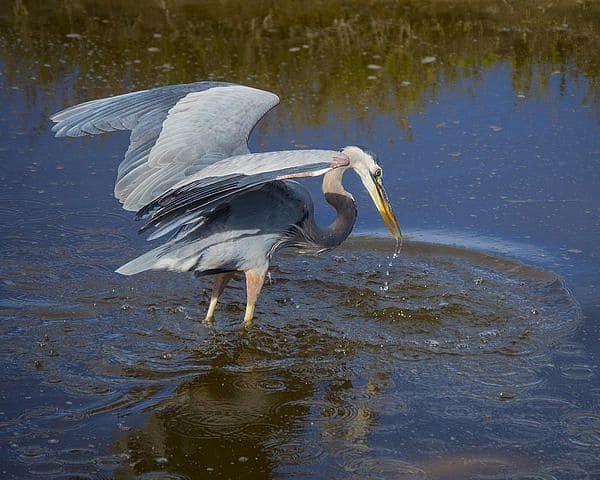
Common habitats include:
Wetlands, marshes, and swamps
Lakes and slow rivers
Coastal bays and tideflats
Predator-free islands or ground nesting sites (rare)
Parks, farms, and urban ponds
Biologists note they choose areas where fish, frogs, and aquatic prey are easy to reach.
The Great White form is more common in coastal saltwater areas.
Seasonal Migration Patterns
Northern Great Blue Herons migrate south in winter. Southern herons stay year-round.
Some herons travel familiar routes shown in range maps. Others remain far north if they find unfrozen patches for winter foraging. Experts observed that herons switch to mice and small animals when fish are scarce. Southern and coastal populations near saltwater usually avoid migration altogether.
Diet and Feeding Behavior
Great Blue Herons eat mostly fish, but they also take frogs, insects, small reptiles, and even rodents when needed. Their diet shifts with the seasons, making them one of the most adaptable hunters in wetlands.
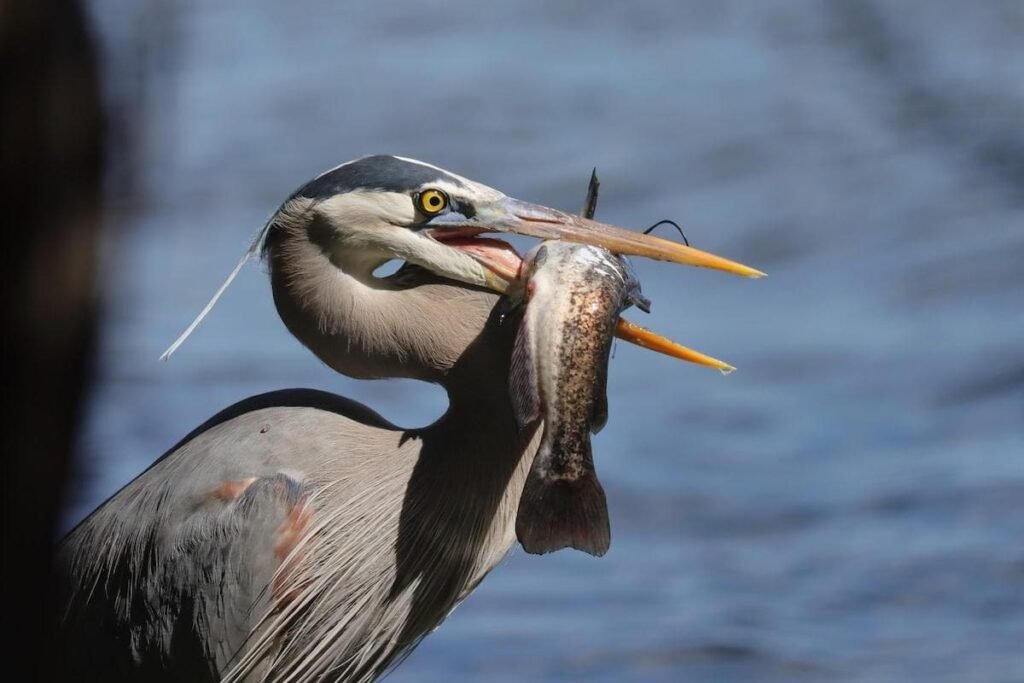
They feed mainly on aquatic prey such as minnows, sunfish, and frogs in shallow water. But researchers in Washington note that mice and voles become a major winter food source when wetlands freeze. This broad diet helps the species survive in almost any habitat you visit.
Herons hunt with a calm, patient style. You’ll often see one standing motionless for minutes before delivering a lightning-fast strike with its long bill. Experts observe that their S-shaped neck works like a spring, adding power to each attack. They stalk quietly through ponds and marsh edges, but they can also forage on land or probe crevices for crustaceans. Some individuals even switch to low-light hunting at night when prey is active.
Behavior and Adaptations
Great Blue Herons spend much of the day moving slowly through wetlands or standing completely still as they watch for prey. Their sharp vision and flexible neck vertebrae let them react in a split second. If you observe one quietly, you’ll notice how it blends into reeds and uses patience as its main hunting tool. Some individuals even catch small birds midair when the chance appears.
These herons rely on several clever adaptations. They strike with a dagger-like bill that can impale fish, then shake the catch to break spines before swallowing prey wider than their narrow neck. In hot weather, experts observe a cooling posture: the beak stays open, the throat vibrates in a gular flutter, and the wings droop to increase airflow. Their slow, steady wingbeats also conserve energy during long flights between feeding sites.
Reproduction and Nesting

Great Blue Herons begin breeding in early spring, when males display long plumes and aerial moves to attract a mate. You often see pairs forming inside large heronries, where dozens of nests sit in tall trees above swamps or islands. Researchers note that bonded pairs stay close during this season and defend their chosen site together.
Nests start small in the first year, built from sticks and leaves, but can grow over several seasons. Females lay 3–5 pale blue eggs, and both parents incubate them for about a month. The chicks hatch helpless and depend on regurgitated food until they can stand, climb, and eventually fly at around 60 days. In good southern climates, some pairs may raise a second brood before the season ends.
Lifespan and Predators
Great Blue Herons (Ardea herodias) usually live around 15 years in the wild, and a few reach over 20 years when conditions are stable. Young herons face the most danger because eggs and chicks are easy targets for predators. As adults gain stronger flight and better hunting accuracy, their survival improves, but threats from eagles, raccoons, and land predators still influence overall longevity.
Key Points (Behavior + Biology Insights)
- Young herons have the lowest survival rate due to limited mobility and nest vulnerability.
- Adults avoid danger by nesting high and using group colonies for extra protection.
- Predators change by stage: mammals target nests, while raptors target juveniles.
- Herons in safer regions like wetlands with tall trees show better long-term survival.
- Heat, storms, and habitat loss also increase age-related mortality in some areas.
Quick Lifespan & Threat Stats
| Factor | Value |
| Average Lifespan (Wild) | ~15 years |
| Max Longevity Record | 23–25 years |
| Sexual Maturity | ~22 months |
| Survival Rate (First Year) | Lowest of all life stages |
| Main Predators | Raccoons, eagles, coyotes, and snakes |
Rare and Fascinating Facts
Great Blue Herons can swallow prey wider than their neck, thanks to flexible throat muscles and a wide gape—biologists say even seasoned observers are surprised when they gulp large fish whole.
Their S-shaped neck hides specialized cervical vertebrae that let them strike with the speed of a thrown spear, a technique different from cranes.
During breeding season, their eyes, bill, and facial skin shift colors—the lore turns blue, the bill glows orange, and the iris becomes reddish.
Some individuals have been seen swimming in deep water when chasing fish, a behavior rarely documented but confirmed in the Northwest.
Their chest has unique powdery bib feathers that release fine dust for grooming, acting like a natural washcloth.
In tall colonies called heronries, a single nest can grow from 20 inches to nearly 4 feet wide after several years of repairs.
Native American nations saw them as symbols of patience and wisdom—the Ojibwe honored their calm presence, while the Cree linked them with good fortune.
Conservation Status
The Great Blue Heron is listed as Least Concern on the IUCN Red List, and long-term community-science surveys show its population is generally stable across the USA and Canada. However, experts warn that colony disturbance, coastal development, and climate-driven habitat loss can still reduce local numbers. Climate models project the species will gain and maintain most of its summer range, but rising seas and wetland degradation remain real risks. Protected areas, habitat restoration, and careful distance from nesting sites help keep these herons secure for the future.
FAQs:
1. What do Great Blue Herons eat?
Great Blue Herons eat fish, frogs, insects, small mammals, and even young birds. Biologists note that they adjust their diet to whatever is easiest to catch. Their long legs and still-hunting posture help them feed in shallow water.
2. How big do Great Blue Herons get?
Adults usually stand about 4 feet tall with wingspans reaching 6–7 feet. Researchers observe that males appear slightly heavier, but both sexes look similar from a distance. Their large wings help them glide with slow, steady strokes.
3. Where do Great Blue Herons live?
They live across North America in wetlands, rivers, lakes, coastlines, and marshes. Field studies show that they choose areas with slow-moving water because it provides safer feeding and better visibility for hunting.
4. How long do Great Blue Herons live?
Most live around 15 years in the wild, though banding records show some reaching 22–25 years. Young birds face higher risks from predators, while adults survive longer due to stronger flight skills and reliable feeding habits.
5. How do Great Blue Herons hunt?
They hunt by standing still and watching for movement, then striking with a fast, spear-like jab. Experts note that their binocular vision and steady posture allow precise targeting, especially in shallow water where prey is exposed.
Conclusion
The Great Blue Heron is a remarkable wading bird, and these Great Blue Heron facts highlight its size, behavior, habitat, and role in wetland ecosystems. Understanding these key details helps birdwatchers and nature lovers appreciate how this species survives and thrives across North America. These facts bring the full picture together in a clear, simple way.
Author Bio:
I’m Ahmed, a nature enthusiast who studies wildlife patterns, bird behavior, and habitat ecology. I focus on creating reliable, easy-to-read animal guides for curious readers.
Sources / References
- National Geographic — Great Blue Heron Facts
https://www.nationalgeographic.com/animals/birds/facts/great-blue-heron - IUCN Red List — Ardea herodias Species Profile
https://www.iucnredlist.org/species/22697620/156526333 - Britannica — Heron Overview
https://www.britannica.com/animal/heron - U.S. Fish & Wildlife Service — Great Blue Heron Species Information
https://www.fws.gov/species/great-blue-heron-ardea-herodias - WWF — Wetland Ecosystems & Conservation
https://www.worldwildlife.org/habitats/wetlands